
Description
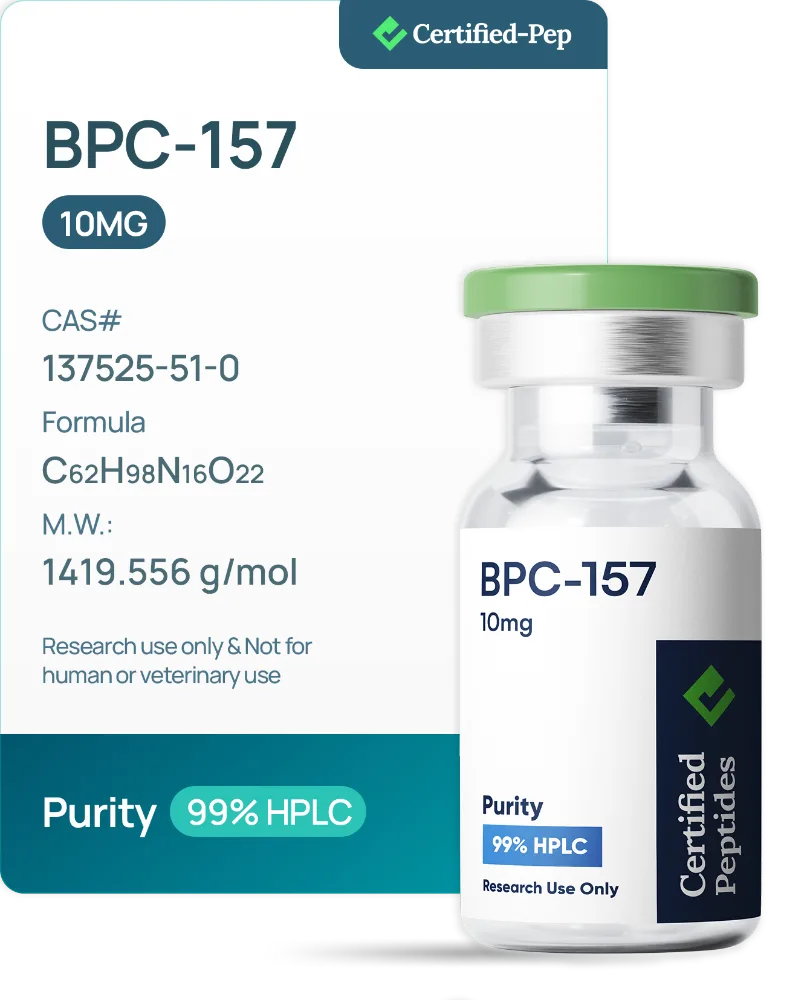
BPC-157 10mg is a 10mg vial of BPC-157, a synthetic pentadecapeptide, made in the USA and supplied as freeze-dried powder. It’s sold for laboratory research only.
BPC-157 at a glance
BPC-157 is a 15-amino-acid peptide based on a fragment of body protection compound, a protein first found in gastric juice. It’s one of the most widely studied research peptides, almost entirely in rodents.
It isn’t an approved drug in the US or Europe, and it’s on the WADA prohibited list.
How BPC-157 acts in the lab
Nobody has pinned down a single receptor for BPC-157. Lab studies point to several pathways: it raises VEGF receptor expression, which feeds blood vessel growth, it interacts with the nitric oxide system, and it increases growth hormone receptor levels in tendon cells.
In cell culture it helped fibroblasts move and spread, which is part of how tissue closes a wound. Those effects are why it shows up so often in tendon, ligament and gut repair models.
BPC-157 10mg product details
- Compound: BPC-157
- Also known as: body protection compound 15, PL 14736
- CAS number: 137525-51-0
- Molecular formula: C62H98N16O22
- Molar mass: 1,419.5 g/mol
- Sequence: Gly-Glu-Pro-Pro-Pro-Gly-Lys-Pro-Ala-Asp-Asp-Ala-Gly-Leu-Val
- Amount: 10mg per vial
- Form: lyophilized (freeze-dried) powder
- Vial size: 3mL glass vial
- Purity: 99% or higher by HPLC
- Made in: USA
- SKU: CP-BPC-10
- Use: laboratory research only
BPC-157 research
Most of the work comes from Predrag Sikiric’s group at the University of Zagreb. Their rodent studies report faster healing of tendon, ligament, muscle and gut injuries, and Mikus and colleagues described improved burn wound healing in mice.
Chang and colleagues reported in 2011 that BPC-157 raised growth hormone receptor expression in rat tendon fibroblasts. Controlled human data are very limited.
For the original studies, try this PubMed search.
How BPC-157 compares
Here’s how BPC-157 10mg fits among related compounds. BPC-157 is the 15-amino-acid repair peptide with the largest body of rodent research. By comparison:
- TB-500 is the 43-amino-acid actin-binding protein, studied for cell movement and wound repair
- KPV is a three-amino-acid alpha-MSH fragment studied for calming inflammation
- ARA-290 is an 11-amino-acid peptide from erythropoietin that protects tissue without raising red cells
- GHK-Cu is the copper-binding tripeptide studied for collagen and skin repair
These are the main peptides in repair research. Each covers a different step, from blood vessel growth and cell movement to calming inflammation and rebuilding the skin matrix. See them all on our healing and recovery peptides page.
How to reconstitute BPC-157 10mg
Concentration is the amount in the vial divided by the volume of water you add. With 10mg of powder in this vial:
- 1mL of bacteriostatic water gives 10mg/mL
- 2mL of bacteriostatic water gives 5mg/mL
- 3mL of bacteriostatic water gives 3.33mg/mL
Go with whichever number is easiest to work with in your protocol, and label the vial with the concentration and the date you mixed it. The vial itself holds 3mL, so that’s the upper limit.
Most labs use sterile bacteriostatic water; we sell it in 10mL and 30mL vials. Warm the sealed vial to room temperature, add the water slowly along the glass wall and swirl gently until it’s clear. Never shake it.
How to store BPC-157 10mg
Freeze-dried BPC-157 10mg handles room temperature fine during shipping, but for anything longer keep it in a freezer at -20°C, away from light. Once mixed, keep it in the fridge at 2 to 8°C and use it within about four weeks.
A 6 vial container keeps open and sealed vials upright and apart, which makes the fridge a lot easier to manage. For a bigger collection, the Big Everything Box holds vials and supplies in one latching case.
BPC-157 10mg purity and lab testing
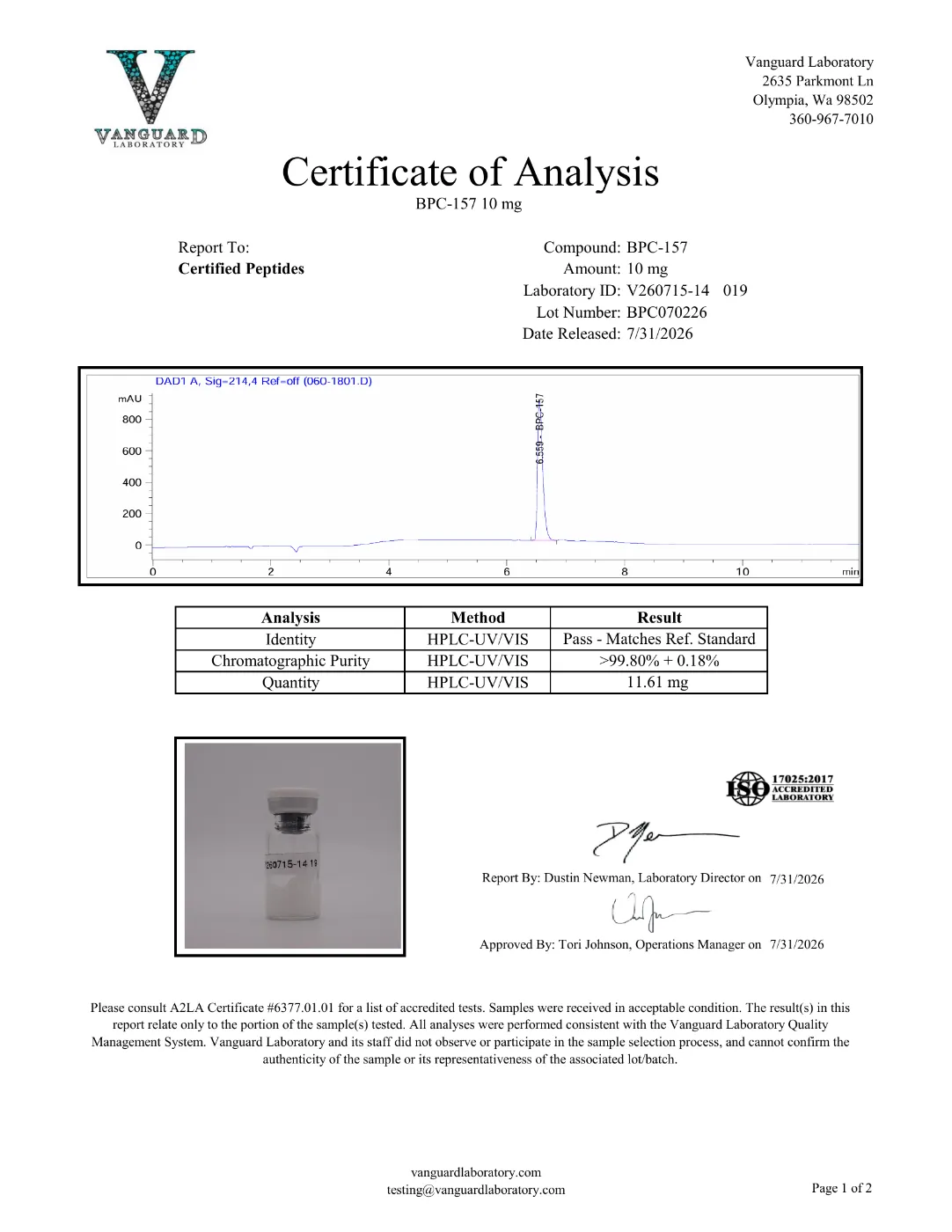
BPC-157 10mg is made in the USA, and every batch goes to an independent U.S. laboratory before it’s sold. The lab confirms identity, measures the content and checks purity by HPLC. Our standard is 99% or higher.
The certificate of analysis for the batch in stock is posted in the product gallery above. Click through the images and you’ll see the lab report with its date and numbers.
On top of purity, each batch is screened for endotoxins, heavy metals and sterility. For cell culture work that screen is often the more important number.
BPC-157 sizes compared
- BPC-157 10mg (this page): $60.00, about $6.00 per mg
- BPC-157 20mg: $90.00, about $4.50 per mg
BPC-157 10mg is the entry size, handy when you only need a little or want to try BPC-157 before committing to a bigger vial.
Related to BPC-157 10mg
- BPC-157 Capsules 500mcg (60 Count), an oral capsule format
- GHK-Cu 100mg, a copper peptide
- BPC-157 TB-500 Cartalax Blend 20mg, BPC-157, TB-500 and Cartalax in one vial
- GLOW KLOW Capsules (60 Count), an oral capsule format
- BPC-157 TB-500 Capsules 500mcg/500mcg (60 Count), an oral capsule format
Browse the full healing and recovery peptides range, or see every vial on our research peptides page.
Common questions about BPC-157 10mg
How much is in the BPC-157 10mg vial?
10mg of freeze-dried powder. The amount is printed on the label.
How should I store it?
Keep sealed vials in the freezer for long-term storage or the fridge for a few weeks. Once mixed, refrigerate and use within about 28 days.
Can BPC-157 be used in people or animals?
No. It’s sold for laboratory research only and isn’t approved for human or veterinary use.
Is BPC-157 10mg in stock?
Yes. BPC-157 10mg is in stock and ships from the U.S.
Where is it made?
In the USA. We only sell U.S.-made research products, and each batch is tested by a U.S. lab.
Order BPC-157 10mg today
Order BPC-157 10mg now for $60.00. It’s in stock, and checkout takes about two minutes. Need water to mix it? Add a 10mL bacteriostatic water to the same order.
Need more for the same project? See the rest of our healing and recovery peptides.
For laboratory research use only. Not for human or veterinary use. These statements have not been evaluated by the FDA.
Reviews
There are no reviews yet.