
Description
The K-Copper blend 70mg from Certified Peptides holds 50mg GHK-Cu and 20mg KPV, freeze-dried together in one vial. It’s made in the USA and sold for laboratory research only.
What the K-Copper blend 70mg contains
GHK-Cu is the tripeptide glycyl-histidyl-lysine bound to a copper ion. GHK occurs naturally in human plasma, saliva and urine, and its levels fall with age.
KPV is the tripeptide lysine-proline-valine, the C-terminal end of alpha-melanocyte stimulating hormone. It keeps alpha-MSH’s anti-inflammatory activity without the pigment effects.
K-Copper skips the repair peptides and pairs GHK-Cu with a larger share of KPV. It’s the simpler choice for skin models where inflammation is the main thing being measured.
K-Copper is 50mg GHK-Cu and 20mg KPV, 70mg in total. Because everything is freeze-dried together, the ratio can’t drift the way it can when you mix separate vials. One reconstitution, one label, the same proportions in every draw.
How the K-Copper blend 70mg works
GHK binds copper tightly and can deliver it to cells. Copper is a cofactor for lysyl oxidase, the enzyme that cross-links collagen and elastin, and for antioxidant enzymes.
Alpha-MSH calms inflammation through melanocortin receptors. KPV is its last three amino acids and keeps much of that anti-inflammatory activity.
K-Copper blend 70mg product details
- GHK-Cu, 50mg: CAS 89030-95-5, C14H22CuN6O4, 401.9 g/mol
- KPV, 20mg: CAS 67727-97-3, C16H30N4O4, 342.4 g/mol
- Amount: 70mg in total (50mg/20mg per vial)
- Form: lyophilized (freeze-dried) powder
- Vial size: 3mL glass vial
- Purity: 99% or higher by HPLC
- Made in: USA
- SKU: CP-KCOPPER-70
- Use: laboratory research only
K-Copper blend research
Loren Pickart, who first isolated GHK in 1973, has published reviews of its effects on collagen synthesis, wound contraction and gene expression in cell and animal studies.
Maquart and colleagues reported that GHK-Cu increased collagen in rat wound chambers.
Dalmasso and colleagues reported in Gastroenterology (2008) that KPV reduced inflammation in mouse colitis models and was taken up through PepT1.
Laroui and colleagues later packaged KPV in nanoparticles and saw similar effects in mice.
For the original studies, try this PubMed search.
K-Copper blend 70mg purity and lab testing
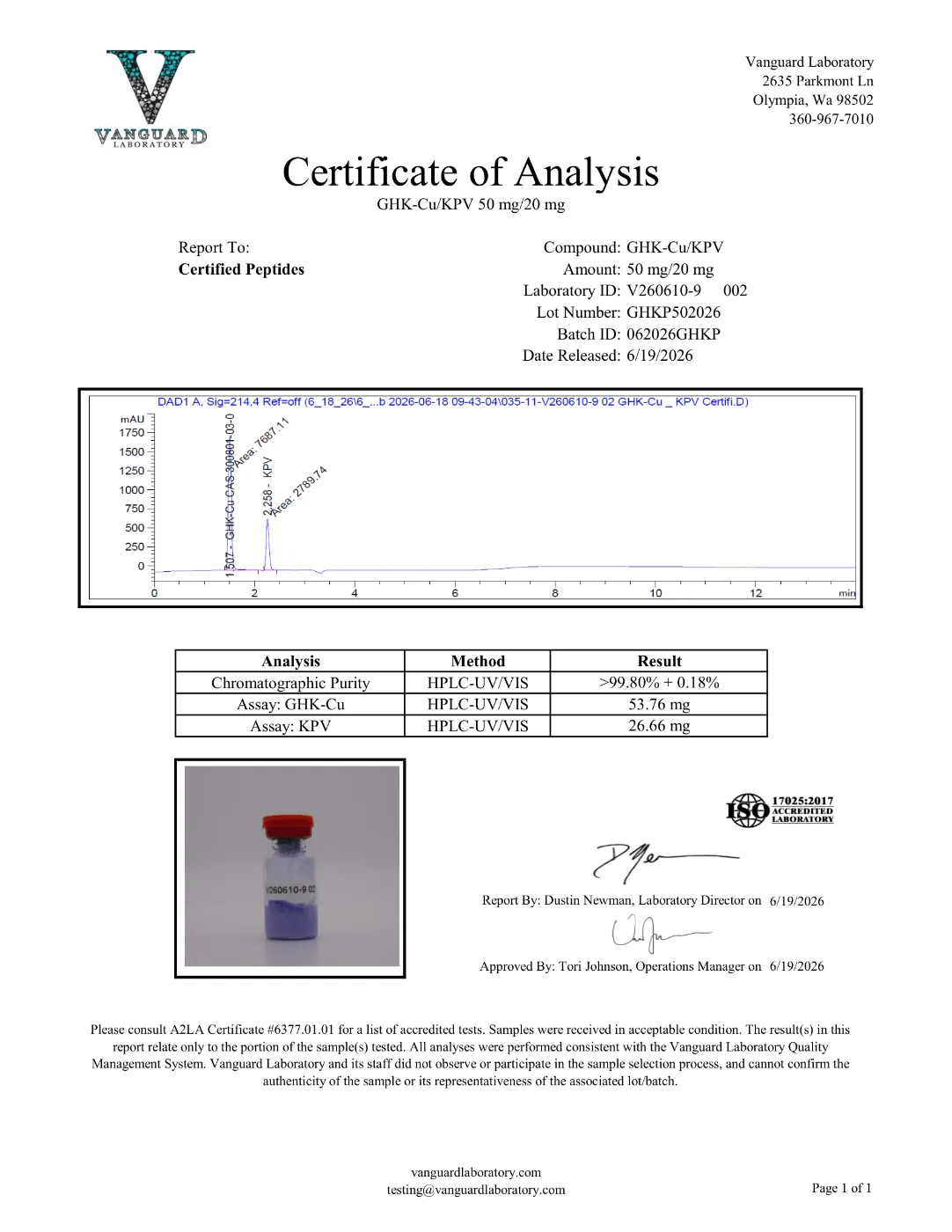
K-Copper blend 70mg is made in the USA, and every batch goes to an independent U.S. laboratory before it’s sold. The lab confirms identity, measures the content and checks purity by HPLC. Our standard is 99% or higher.
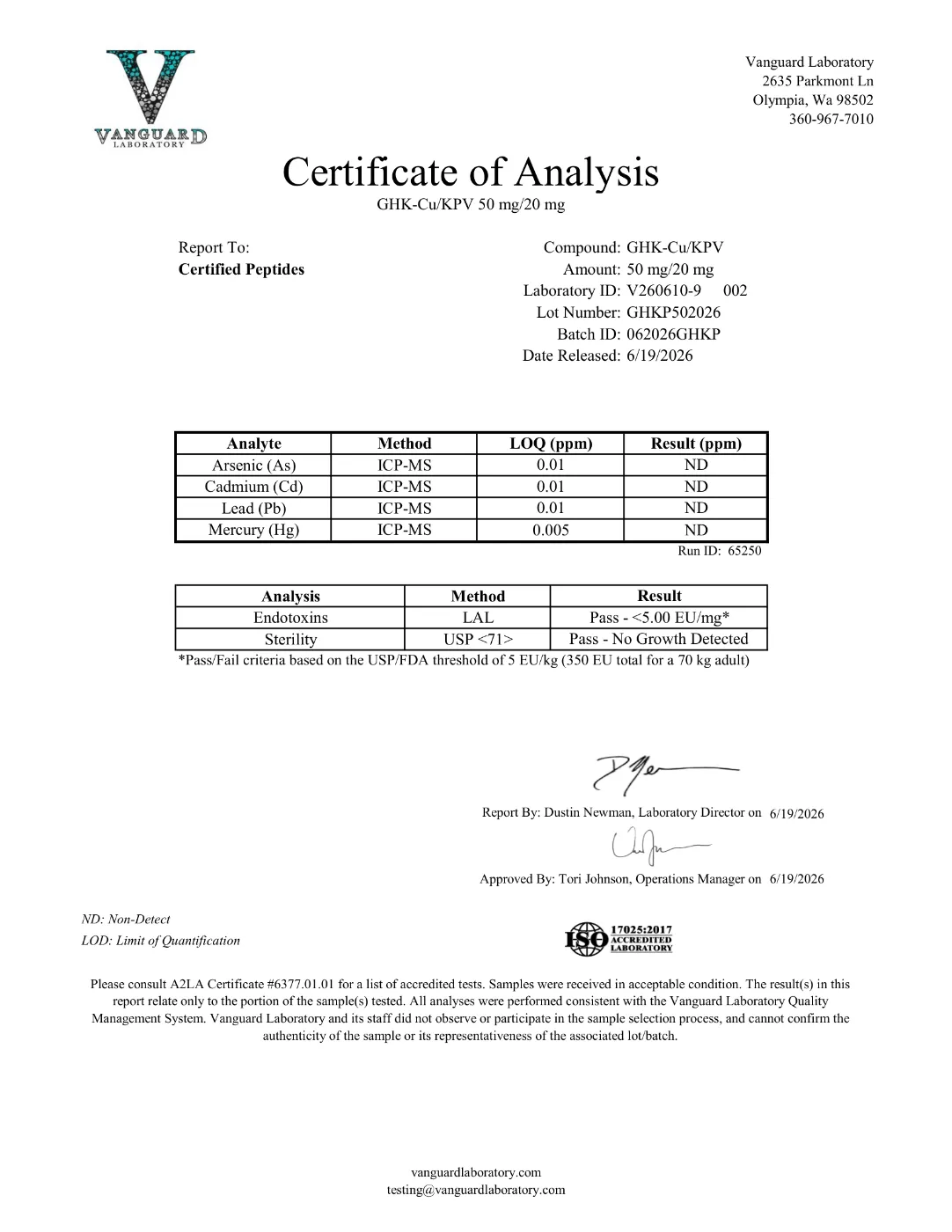
The certificate of analysis for the batch in stock is posted in the product gallery above. Click through the images and you’ll see the lab report with its date and numbers.
Purity isn’t the whole story, so batches are screened for endotoxins, heavy metals and sterility too. Write the batch number from the label into your notes so you can match results to the paperwork later.
K-Copper blend 70mg reconstitution and concentration
Here’s the math for 70mg of powder:
- 2mL of bacteriostatic water gives 35mg/mL
- 3mL of bacteriostatic water gives 23.33mg/mL
Choose the volume that suits your measurements. Mark the vial with the concentration and date so nobody has to guess later. The vial itself holds 3mL, so that’s the upper limit.
Bacteriostatic water is the usual choice. Add it slowly so it runs down the side of the vial, then swirl or roll until everything dissolves. Shaking can shear peptide chains. Skip it.
How to store K-Copper blend 70mg
The dry powder keeps best cold. A freezer at -20°C is ideal for long-term storage, and a fridge works for a few weeks. After reconstitution, store it in the fridge and finish it within roughly four weeks.
A 6 vial container keeps open and sealed vials upright and apart, which makes the fridge a lot easier to manage. For a bigger collection, the Big Everything Box holds vials and supplies in one latching case.
Planning a study with K-Copper blend 70mg
Work out the total amount before you order. Add up what each arm of the study uses across every time point, then divide by 70mg. Round up by one vial so a spoiled sample or a repeat run doesn’t stall the project.
Mix one vial at a time and keep the rest sealed in the freezer. Dry powder keeps far longer than solution, so there’s no reason to reconstitute everything at the start.
If you order more than one vial, check that the batch numbers match before you start. Running a whole study on one batch removes one variable.
Related to K-Copper blend 70mg
- AHK-Cu Raw Powder (1 Gram), bulk powder for formulation work
- Lemon Bottle 103.5mg/mL (10mL), a ready-made 10mL liquid
- Acetyl Hexapeptide-8 Raw Powder (1 Gram), bulk powder for formulation work
- Glow Tropic (10mL), a ready-made 10mL liquid
- Melanotan II 10mg (MT2), a melanocortin agonist
Browse the full skin and tanning peptides and healing and recovery peptides range, or see every vial on our research peptides page.
K-Copper blend 70mg questions
How much is in the K-Copper blend 70mg vial?
50mg of GHK-Cu and 20mg of KPV, freeze-dried together. The amount is printed on the label.
How should I store it?
Keep sealed vials in the freezer for long-term storage or the fridge for a few weeks. Once mixed, refrigerate and use within about 28 days.
Can K-Copper blend be used in people or animals?
No. It’s sold for laboratory research only and isn’t approved for human or veterinary use.
Is K-Copper blend 70mg in stock?
Yes. K-Copper blend 70mg is in stock and ships from the U.S.
Where is it made?
In the USA. We only sell U.S.-made research products, and each batch is tested by a U.S. lab.
Buy K-Copper blend 70mg from Certified Peptides
Order K-Copper blend 70mg now for $90.00, down from $110.00. It’s in stock, and checkout takes about two minutes. Need water to mix it? Add a 10mL bacteriostatic water to the same order.
Need more for the same project? See the rest of our skin and tanning peptides and healing and recovery peptides.
For laboratory research use only. Not for human or veterinary use. These statements have not been evaluated by the FDA.
Reviews
There are no reviews yet.