
Description
Our Buffered NAD+ 1000mg vial holds 1000mg of lyophilized NAD+, a coenzyme, made and tested in the USA. It’s sold for laboratory research only.
Buffered NAD+ is NAD+ with a buffer added so the mixed solution sits closer to neutral pH. Plain NAD+ makes a fairly acidic solution, and some labs prefer the buffered version for that reason.
About NAD+
NAD+ (nicotinamide adenine dinucleotide) is a coenzyme in every living cell. It carries electrons in energy metabolism and is a substrate for sirtuins and PARPs.
Its levels drop with age in many tissues.
How NAD+ works
NAD+ shuttles electrons in glycolysis, the Krebs cycle and the mitochondrial chain, so it’s needed to turn food into ATP. It’s also used up by sirtuins, which regulate gene expression, and by PARPs, which repair DNA.
Because those enzymes consume it, NAD+ levels depend on constant recycling. Falling levels with age are linked to lower sirtuin activity, which is the basis for most NAD+ aging research.
Buffered NAD+ 1000mg specifications
- Compound: NAD+
- Also known as: nicotinamide adenine dinucleotide
- CAS number: 53-84-9
- Molecular formula: C21H27N7O14P2
- Molar mass: 663.4 g/mol
- Structure: dinucleotide coenzyme
- Amount: 1000mg per vial
- Form: lyophilized (freeze-dried) powder
- Vial size: 10mL glass vial
- Purity: 99% or higher by HPLC
- Made in: USA
- SKU: CP-BNAD-1000
- Use: laboratory research only
What the research says about NAD+
Reviews by Imai and Guarente, and by Verdin, cover the link between falling NAD+ and aging.
Precursors like NR and NMN have been tested in small human trials.
For the original studies, try this PubMed search.
How NAD+ compares
Labs choosing Buffered NAD+ 1000mg usually weigh it against a few close relatives. NAD+ is the coenzyme behind cell energy and sirtuin activity, whose levels fall with age, while:
- Epithalon is the tetrapeptide Ala-Glu-Asp-Gly, studied for telomerase activity
- SS-31 targets cardiolipin on the inner mitochondrial membrane
- Glutathione is the cell’s main antioxidant tripeptide
- MOTS-c is a 16-amino-acid peptide coded in mitochondrial DNA, studied for glucose use in muscle
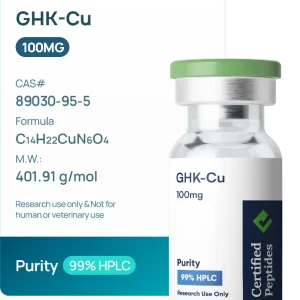
- GHK-Cu is the copper-binding tripeptide studied for collagen and skin repair
Aging research splits into a few processes, and each of these compounds targets one: telomeres, cell energy, mitochondria, oxidative stress or tissue repair. See them all on our anti-aging peptides page.
How to reconstitute Buffered NAD+ 1000mg
The amount of liquid you add sets the concentration. For a vial holding 1,000mg:
- 3mL of bacteriostatic water gives 333.33mg/mL
- 5mL of bacteriostatic water gives 200mg/mL
- 10mL of bacteriostatic water gives 100mg/mL
Pick the volume that keeps your own calculations simple, then write the concentration and the mixing date on the label. The vial itself holds 10mL, so that’s the upper limit.
Bacteriostatic water is the usual choice. Add it slowly so it runs down the side of the vial, then swirl or roll until everything dissolves. Shaking only adds foam. Skip it.
Storing Buffered NAD+ 1000mg
Store sealed vials of Buffered NAD+ 1000mg in the freezer (-20°C) or the fridge (2 to 8°C), out of direct light. Mixed solution goes back in the fridge and should be used within about 28 days.
Vials are small and easy to knock over or misplace. Our 6 vial and 10 vial containers keep a whole study’s worth together.
Buffered NAD+ 1000mg purity and lab testing
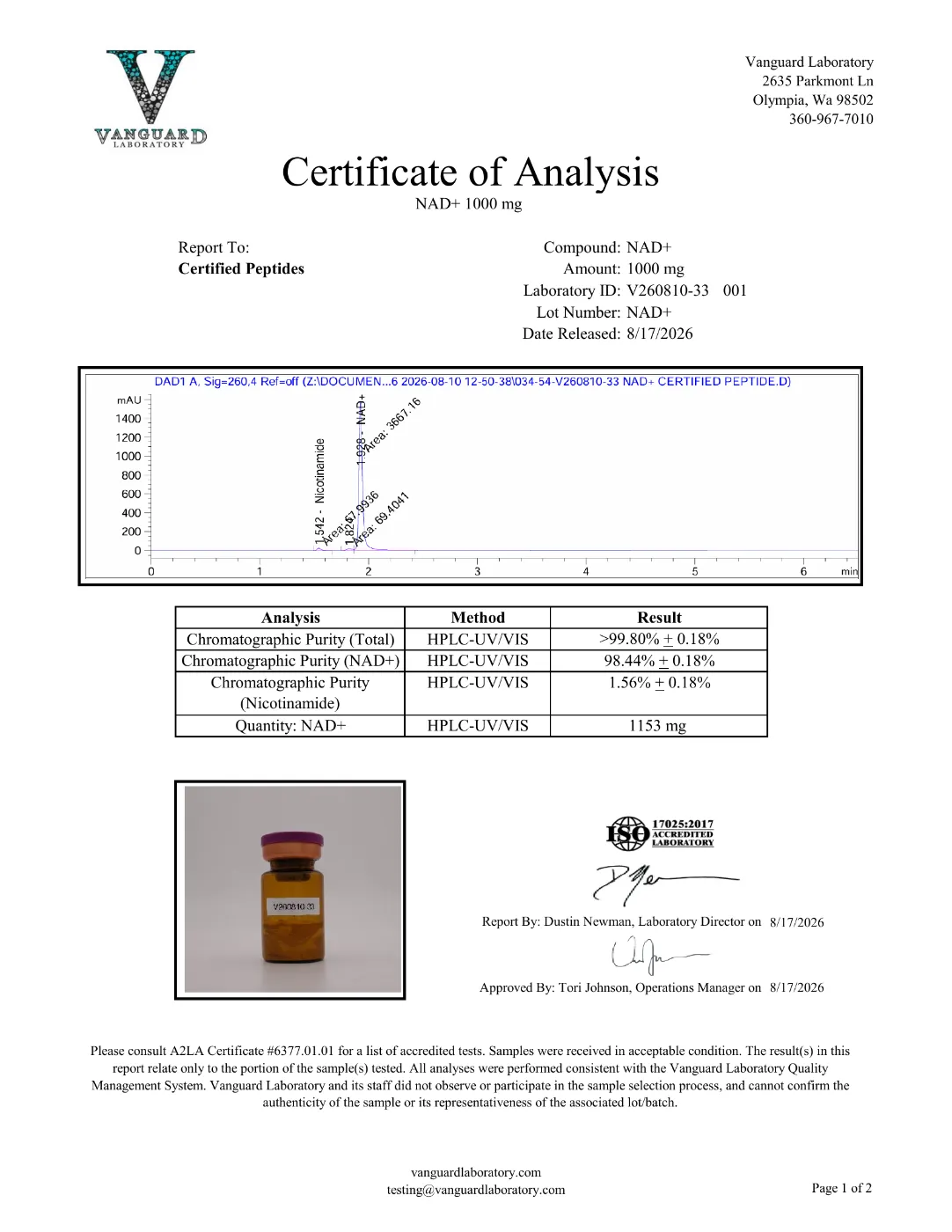
Every batch of Buffered NAD+ 1000mg is made in the USA and checked by an independent U.S. lab for three things: that it’s the right compound, that the amount matches the label and that purity is 99% or better by HPLC.
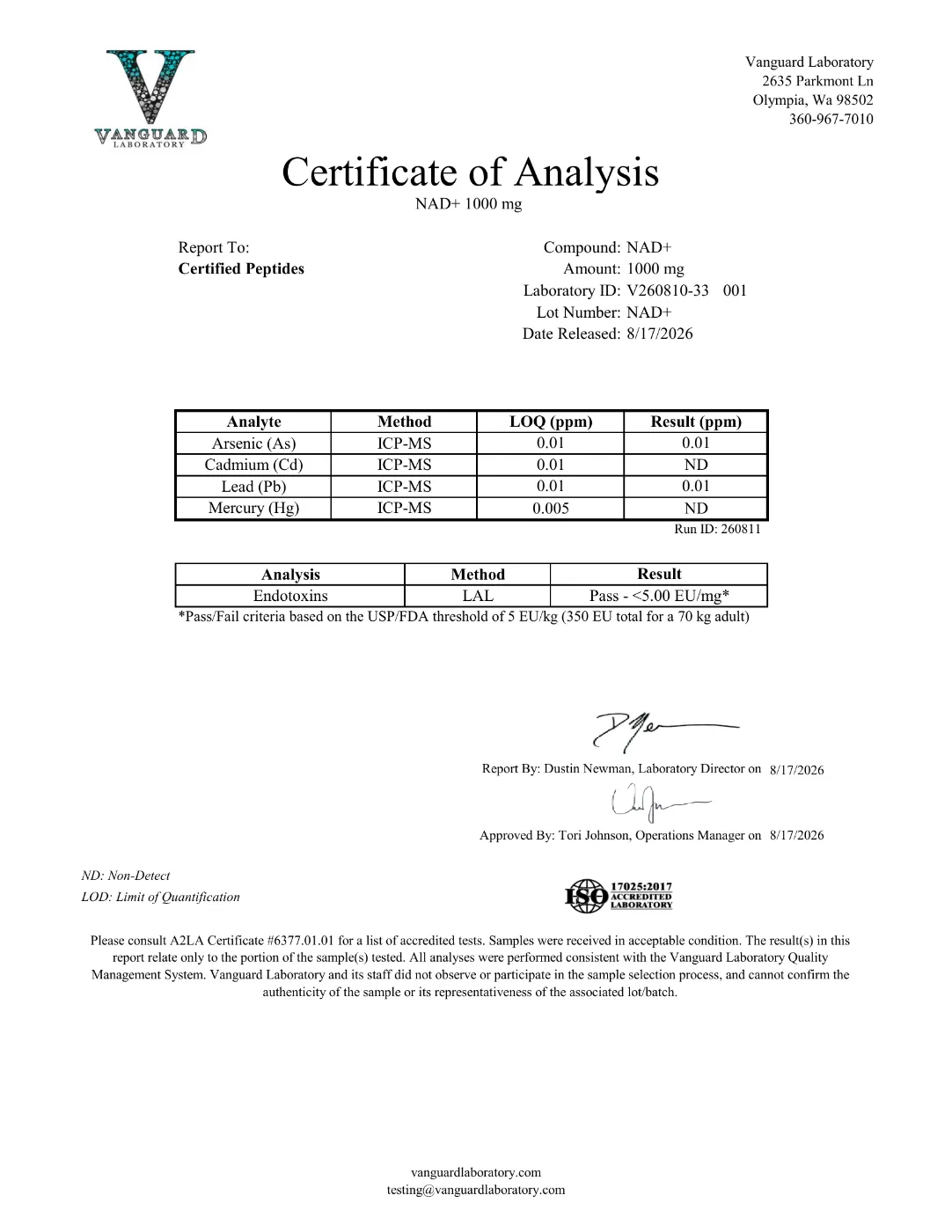
The certificate of analysis for the batch in stock is posted in the product gallery above. Click through the images and you’ll see the lab report with its date and numbers.
Purity isn’t the whole story, so batches are screened for endotoxins, heavy metals and sterility too. Write the batch number from the label into your notes so you can match results to the paperwork later.
NAD+ sizes compared
- Buffered NAD+ 500mg: $90.00, about $0.18 per mg
- Buffered NAD+ 1000mg (this page): $130.00, about $0.13 per mg
For longer projects Buffered NAD+ 1000mg works out cheaper per milligram than the small vial, and you’ll reorder less often.
Other anti-aging peptides to look at
- Epithalon 50mg, a tetrapeptide
- SS-31 30mg, a mitochondrial peptide
- Glutathione 1500mg, an antioxidant tripeptide
- NAD+ 500mg, a coenzyme
- MOTS-c 40mg, a mitochondrial peptide
Browse the full anti-aging peptides range, or see every vial on our research peptides page.
Buffered NAD+ 1000mg FAQ
How much is in the Buffered NAD+ 1000mg vial?
1000mg of freeze-dried powder. The amount is printed on the label.
Is there a certificate of analysis for Buffered NAD+ 1000mg?
Yes. The current batch’s COA is in the image gallery on this page.
What do I mix Buffered NAD+ 1000mg with?
Sterile bacteriostatic water is the usual choice. The reconstitution section above shows the concentration for each volume.
How should I store it?
Keep sealed vials in the freezer for long-term storage or the fridge for a few weeks. Once mixed, refrigerate and use within about 28 days.
Can NAD+ be used in people or animals?
No. It’s sold for laboratory research only and isn’t approved for human or veterinary use.
Buy Buffered NAD+ 1000mg online
Buffered NAD+ 1000mg is in stock at $130.00. Add it to the cart and check out in a couple of minutes.
Need more for the same project? See the rest of our anti-aging peptides.
For laboratory research use only. Not for human or veterinary use. These statements have not been evaluated by the FDA.
Reviews
There are no reviews yet.